Safety and limits
Read this before you go in.
It is short, and it matters. Every person sees this page inside the app before they can use it, and has to agree to it. We would rather you know exactly what Clearly can and cannot do.
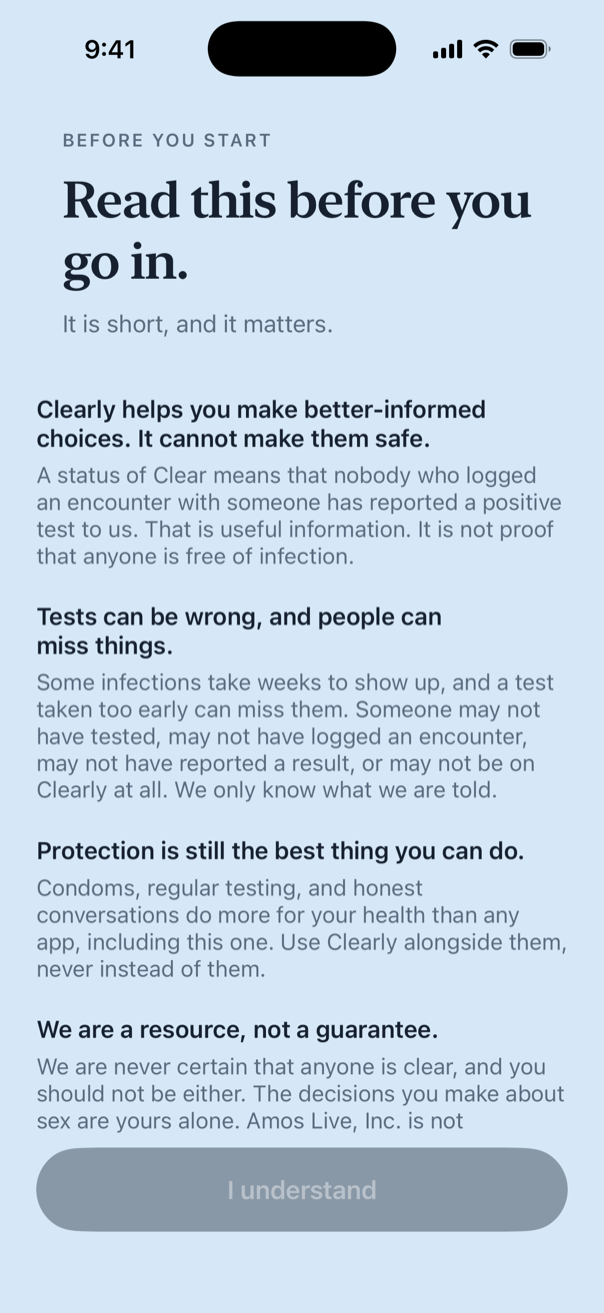
Clearly helps you make better-informed choices. It cannot make them safe.
A status of Clear means that nobody who logged an encounter with someone has reported a positive test to us. That is useful information. It is not proof that anyone is free of infection.
Tests can be wrong, and people can miss things.
Some infections take weeks to show up, and a test taken too early can miss them. Someone may not have tested, may not have logged an encounter, may not have reported a result, or may not be on Clearly at all. We only know what we are told.
Protection is still the best thing you can do.
Condoms, regular testing, and honest conversations do more for your health than any app, including this one. Use Clearly alongside them, never instead of them.
We are a resource, not a guarantee.
We are never certain that anyone is clear, and you should not be either. The decisions you make about sex are yours alone. Amos Live, Inc. is not responsible or liable for those decisions or for what follows from them. Our Terms of Service say the same.
What Clear means
Three statuses, and one honest shade of grey.
Clear
Nobody who logged an encounter with you within the relevant window has reported a positive test, you have no open alert, and your verified tests cover the basic panel: chlamydia, gonorrhea, syphilis, and HIV.
Needs a test
You have an open alert. Someone you have been with, or someone they have been with, reported something. The alert names the infection and the earliest date a test can rule it out.
Positive
You reported a positive test and have not yet added a clean result dated after it. The people you clear with see this status, and only this status.
Clear, but uncertain
Nobody has reported anything that reaches you, but your verified tests do not yet cover the basic panel. The app says so in those words, tells the other person that nothing backs it up, and shows exactly which infections your tests did cover. It is their call. Once the basic panel is covered, the status reads simply Clear.
Window periods
Why a test from last week might not count.
Each infection takes time to show on a test. Clearly knows those window periods and uses them in two directions.
- Deciding who to alert. A report reaches everyone logged with the reporter on or after the earliest date they could have been infectious: one window before their last clean test. Then everyone those people were with after their own exposure. Nobody from before the window is alerted.
- Clearing an alert. A result from before the retest date cannot rule the infection out, so it does not clear the alert. The app tells you the earliest date that counts.
- Never stating the window. The app never says how long any window is, so a retest date can never be read backwards into an exposure date, and an alert can never point at a person.
Infections Clearly tracks
Herpes is not included on purpose. It is very common, often lifelong, usually diagnosed from symptoms rather than routine screening, and a window-based alert would mislead more than it helps. Talk to a provider about it directly.
If you get an alert
It means you may have been exposed. Not that you are infected.
Get tested on or after the date shown
Testing too early can miss it. If you have symptoms, see a provider right away and do not wait for the date.
Add the result to Clearly
A verified clean test dated on or after the retest date clears the alert and your status goes back to Clear.
Do not go looking for who
The alert deliberately contains nothing that identifies anyone, and Clearly will never confirm a guess. Pressuring, exposing, or retaliating against anyone breaks our terms and, in many places, the law.
Where to get tested
Testing is easier than most people think.
In the United States, gettested.cdc.gov lists free and low-cost testing near you. Planned Parenthood, local health departments, and many pharmacies and clinics also offer testing. Many places let you test without a parent or insurance.
Not medical advice
Clearly is an information tool. It does not diagnose, treat, or replace a healthcare provider. Talk to a provider about testing, symptoms, exposure, and treatment. If you are in immediate danger, contact local emergency services.